MakerKit vs Achromatic: the short answer
Choose MakerKit if you want a kit maintained since 2022 with a dated changelog, a Supabase edition with Row Level Security, personal, team, or hybrid account modes, metered billing, i18n, and AGENTS.md plus an MCP server for coding agents. Choose Achromatic if the lowest price for multi-tenancy matters most and a short public history does not worry you.
We build MakerKit, so weigh this page accordingly. Achromatic pricing was checked on its site in September 2026 and its features in July 2026. Our reservation about Achromatic is evidence of maintenance, not the quality of its code.
Why developers look for an Achromatic alternative
- Track record. When an agent can write a feature in an afternoon, what you pay for is the maintainer keeping up with Next.js, React, and your auth library for years. Achromatic is newer, with little public history to judge. MakerKit has been maintained since 2022 and publishes a dated changelog.
- They want Supabase. Achromatic is Prisma and Drizzle only. MakerKit's Supabase kits enforce tenant isolation with Postgres RLS and include Supabase Auth and Storage.
- Agent tooling for building, not only AI features. The AI SDK scaffolding adds AI features to your product. AGENTS.md files and an MCP server help your coding agent build the product. MakerKit ships both kinds of agent support; Achromatic's docs did not include agent instructions or an MCP server when we checked.
- Billing and markets beyond Stripe and English. MakerKit adds metered billing, more payment providers, and a fully translatable UI. None of these were documented features of Achromatic when we checked.
MakerKit vs Achromatic: feature comparison
MakerKit features are documented in its public docs. Achromatic features are marked from its public site and docs, checked in July 2026, with pricing checked in September 2026.
| Feature | MakerKit | Achromatic |
|---|---|---|
| Pricing model | One-time license per developer or team, lifetime updates | One-time, $180, unlimited projects and developers (listed September 2026) |
| Web frameworks | Next.js, TanStack Start, React Router | Next.js only |
| Native mobile app | Expo (React Native) kit for iOS and Android | Not offered |
| Auth and data layer | Supabase Auth + RLS, or Better Auth with Drizzle or Prisma (one kit per license) | Better Auth with Prisma and Drizzle, both in one license |
| Standalone typed API layer | Server actions and route handlers instead | tRPC |
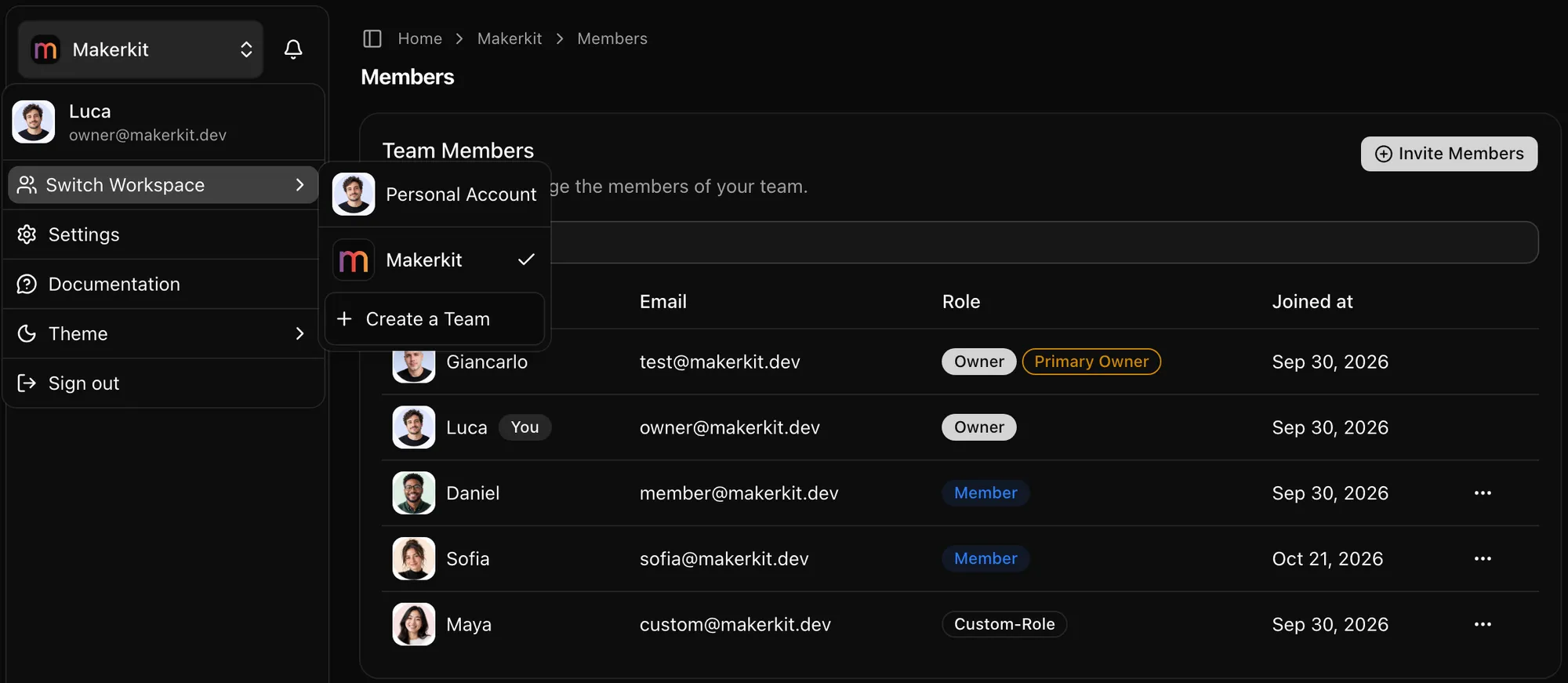
| Multi-tenancy (orgs/teams, invites, roles) | Team accounts with invitations and role-based permissions | Organizations with members, invitations, and roles |
| Account modes (personal/team/hybrid) | Personal-only, team-only, or hybrid via feature flags | Not documented |
| Seat-based billing | Per-seat plans documented in every kit | Seat-based subscriptions supported |
| Metered / usage billing | Metered usage; credit-based billing recipe on the Supabase kits | Not documented |
| Payment providers | Stripe or Lemon Squeezy (Supabase kits); Stripe or Polar (Drizzle, Prisma) | Stripe documented |
| AGENTS.md, agent rules, MCP server | Agent rules for Claude Code, Cursor, Codex, Gemini, Windsurf; MCP server included | Not in its docs when we checked (September 2026) |
| Playwright E2E tests | Suite covering auth, billing, and team flows | Playwright tests included |
| Internationalization (i18n) | Fully translatable UI | Not documented |
| Docker and Cloudflare deployment | Docker in every Next.js kit; Cloudflare guide on the Supabase kit | Docker-based deployment; Cloudflare not documented |
| Repository structure | Turborepo monorepo with per-package agent instructions | Single Next.js app |
| Public maintenance history | Maintained since 2022, dated public changelog | Newer kit, short public history |
Legend: green check, documented first-class feature. Yellow minus, partial or limited. Grey circle, not documented when we checked.
Where MakerKit wins, and where Achromatic wins
MakerKit is the better buy if
- You want to check maintenance before you pay: a dated changelog and public docs covering the current Next.js and React versions.
- You want Supabase with RLS, or the same architecture on TanStack Start, React Router, or an Expo mobile app.
- Some customers are individuals and some are companies, and you want hybrid account modes without a redesign.
- Your pricing includes usage, or you sell outside English-speaking markets.
- You build with Claude Code, Cursor, or Codex and want AGENTS.md, agent rules, and an MCP server from day one.
Achromatic is the better buy if
- Price decides it. $180 for organizations and roles is well below MakerKit Pro.
- Several developers need access and you want one license to cover them all. MakerKit's Developer license is for one person; teams buy a Team license.
- You like tRPC, or want both ORMs in the repository to compare.
- You prefer a single Next.js app over a monorepo and do not need Supabase, i18n, or metered billing.
Three trade-offs worth thinking through
Sticker price vs total cost
The license gap is real, and at the $150/hour rate in our SaaS starter kit cost analysis it is roughly an hour of senior developer time. Hybrid account modes, metered billing, or i18n each take longer than that to build if your product ends up needing them.
Two ORMs vs one deep kit
Achromatic includes Prisma and Drizzle in one license. You will ship on one of them. MakerKit licenses one kit per stack, each with its own documentation, and offers a discount if you switch stacks later.
Single app vs Turborepo
A single app is simpler on day one. In MakerKit, kit code lives in packages and your code lives in the app, so pulling upstream updates rarely collides with your changes, and Turborepo caches typechecks and builds per package. Each package also carries its own agent instructions.
What you get with MakerKit
- The license: a one-time purchase that adds you to the private GitHub repository, with lifetime updates and unlimited products for your own business. See the license terms for Developer and Team licenses.
- Support: the Discord community, where the maintainer answers kit questions. Team licenses add a private channel.
- Try before you buy: the documentation is public, so you can read the architecture before paying. Because you receive the full source, refunds are generally not offered once repository access is redeemed; details in the FAQ.
Inside MakerKit

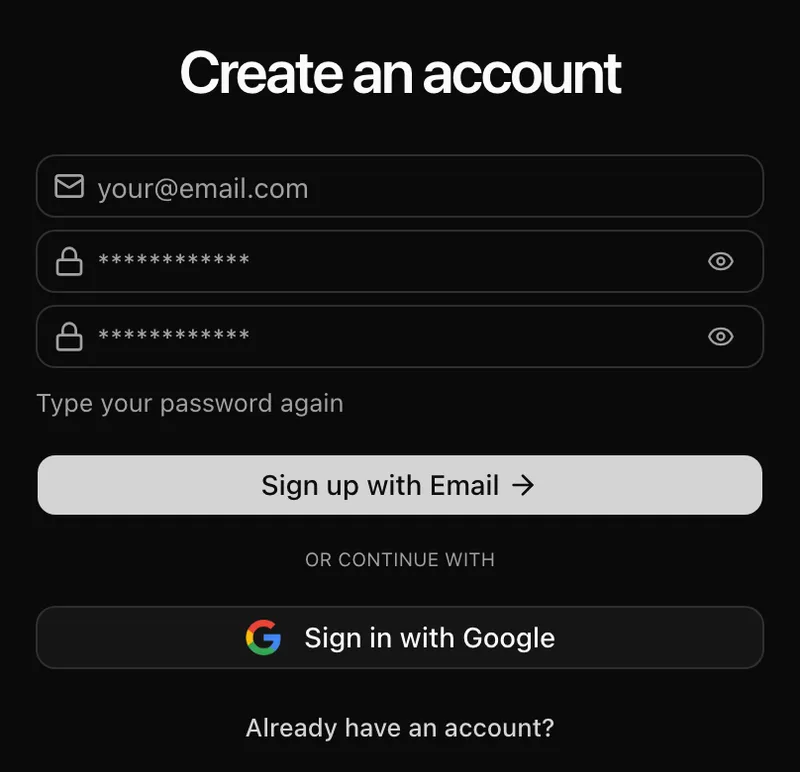
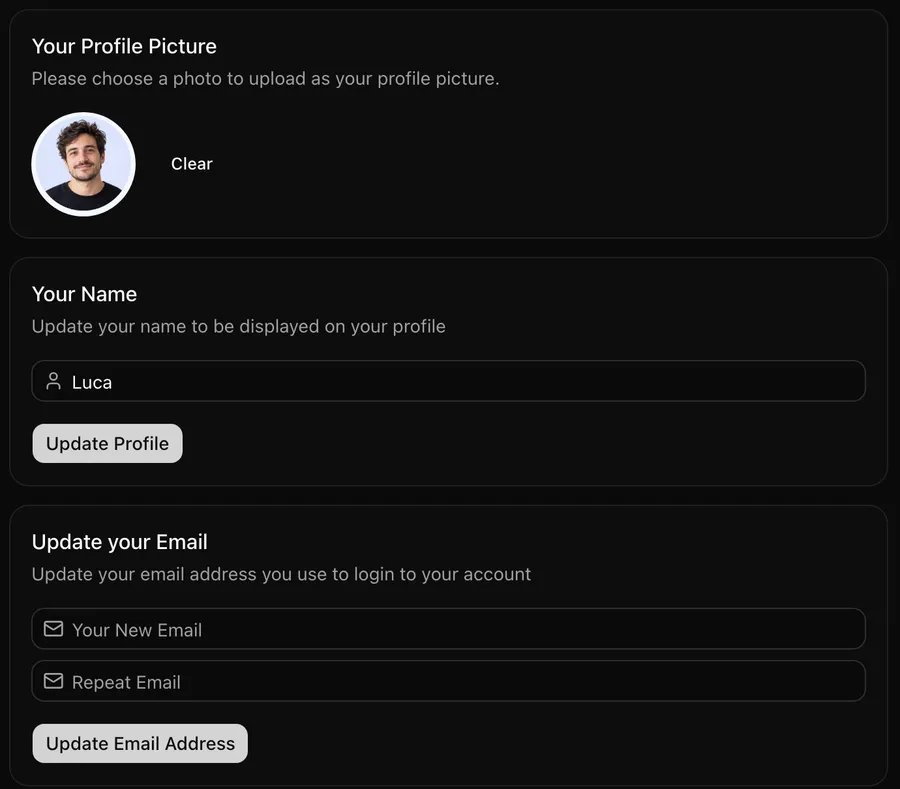
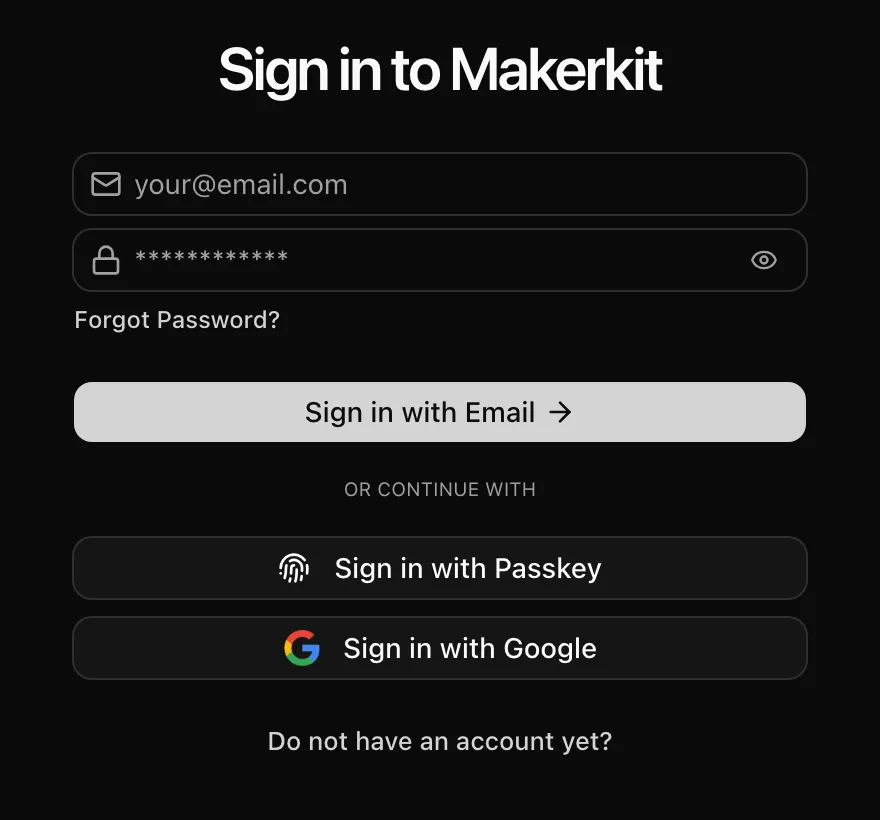
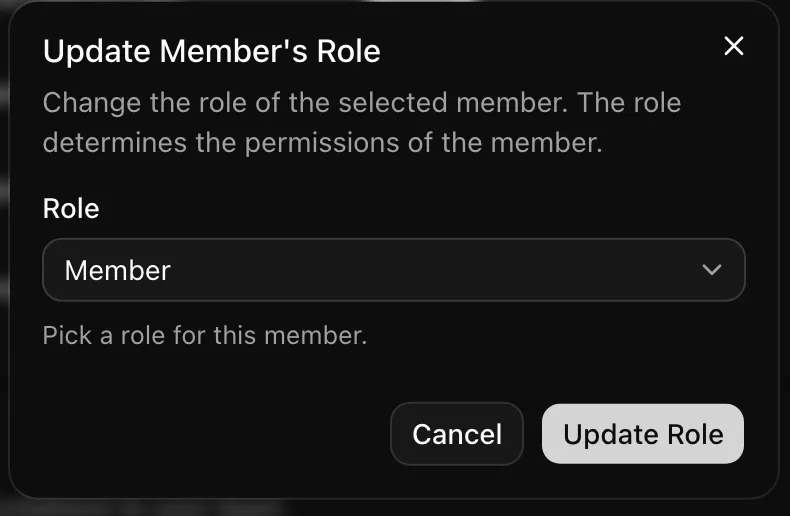

> Add a projects table scoped to team accounts
Context your harness loads
Root rules first, then the folder the agent works in
Products built on MakerKit
 AmplefoundAI-organic growth agent
 GondlaThe first content engine designed for Hybrid Search Visibility
 ConvoQualitative Research At Scale
 QA.techShip faster with AI agents that create and run your QA tests
 ReplybossFind relevant posts on X. Grow faster and sell more.
 ReplenoInventory management for craft & small businesses
See 16 more products from MakerKit customers +
- Badvisor · Unlock the Power of Web 3D
- iMaintain · Smarter Care for Everything You Own
- Blastra · Get In Front Of The Right Audience In One Go
- SNutils · Superpowers for ServiceNow Professionals
- Videotok · Create viral TikToks and Reels from text to video with AI
- Nero AI · The LLM powered scraper for LLM Apps
- FormLabs · Create & Analyze Your Bespoke Survey in Seconds
- Permitful · Permit tracking for architects
- Revarta · Practice Interviews to Land your Next Job
- ExtensionAuditor · Scan Browser Extensions. Detect Hidden Threats
- ShortlistIQ · AI Powered screening and hiring
- CareerKit · AI-powered career coaching for software engineers
- ChefGPT · AI-powered digital Chef to the rescue for never-ending delicious meals
- Superlines · The AI tool for Marketing
- YTSummary · Get the gist of any YouTube video with AI summaries
- CodeSnippets AI · GPT-4 and collaborate with your team to build your secure code snippets library
What customers say
Developers and founders on the kits, the docs and the support. Every quote links to the original post.
just wanna say thanks to @gc_psk for building @makerkit_dev . it is such an overpowered template. like finally we have a really good one with active development, good docs and now even cursorrules/windsurfrules to just sit down and see ai agents do the stuff. truly mindblowing.

Built and maintained full-time by Giancarlo, a software engineer with almost 15 years of experience at startups and enterprises. Support questions reach me directly.
My favorite so far is @gc_psk and @makerkit_dev ship cursor rules along with updates to the framework. That's been really useful to pull in new version (via git remote) and things stay in sync.
Just started using MakerKit and it's a total game-changer. 🚀 Wish I had this when I was building Phishr. Instant team management and billing? Insane.
Second that! Giancarlo provides amazing support!! 😄
You need to check @makerkit_dev by @gc_psk — it’s the best I’ve seen so far. It’s feature complete, plenty examples, amazing docs, great Discord community, the dude provides support even days after his weeding (which is crazy!) I’m not affiliated in every way, just a happy cx.
Honestly @makerkit_dev is great. More for B2B products but really clean and well documented.
Amazing! @gc_psk has built a masterpiece with this one!
I just stumbled upon @makerkit_dev (and you!), it's impressive, I thought it was a big team behind how many features I saw (and I've been working in software a long time!) I was just looking for a free boilerplate, but the lifetime licence makes it a no brainer. Thank you!
I would have totally agreed with you until… I found @makerkit_dev last year. This is by far, the best boilerplate I found those past years. The dev is pushing new features and updates almost every week. His documentation (specially migrating to Next 15) is the best I’ve seen.
Makerkit is a gem for makers, if I was not building a desktop app I would be using it for sure, maybe for my next project
I landed on MakerKit after getting into boilerplates with ShipFast. Much better.
1000% recommend buying a good boilerplate (or making your own) I use @makerkit_dev it's so good I had an affiliate link, but I can't find it at the moment
For anyone who wants to build their own SaaS, I recommend trying out @makerkit_dev. Thanks to @gc_psk for creating such a fantastic tool that makes building websites a breeze! #SaaS #buildinpublic
We loved the product since when Giancarlo released the first version, and are building upon it ever since for all of our products. Highly recommended for all indie makers out there.
Solid and battle tested boilerplate with an amazing community and support.
The rows a cheaper kit leaves you to build
Compare kits on how much of this table they cover and how well they keep covering it after launch. With AI coding tools, that is still 49-81 hours of senior developer time, including fixing the patterns AI got wrong.
- Maintained full-time
- Since 2022
- Kits across 4 frameworks
- 8
- Data layers: Supabase, Drizzle, Prisma
- 3
Hours with Claude Code or Cursor · bar shows the range on a 0–25h scale
Estimates for a senior developer building from scratch with Claude Code or Cursor at $150/hour, including 15-25 hours refactoring AI-generated patterns. Read the methodology
Choosing MakerKit over Achromatic? Pick your stack
One-time purchase: lifetime license, continuous updates, unlimited projects of your own.
- Lifetime access to your stack of choice
- Build unlimited applications
- Continuous updates
- Access to the Discord community
- The best support in the SaaS Starter kits market, period.
- Community and Chat support
- Community-based feature requests and Request for Comments. You have a say in what Makerkit should build next.
- One-time payment, no subscriptions
- Includes access to our free Figma UI kit
Choose your Stack
Select the technology stack that best fits your project
Questions about licensing?
Read the MakerKit license terms and the MakerKit FAQ, or contact me.
Why Achromatic is popular
Achromatic packs a lot into a low price. Its site listed $180 as a one-time payment in September 2026, with lifetime updates and unlimited projects and developers. That makes it the lowest-priced paid multi-tenant kit in our comparison, with organizations, member management, invitations, and roles.
The stack is current: Next.js 16, Better Auth, Prisma or Drizzle (both included in one license), tRPC for the API layer, Tailwind, Shadcn UI, Playwright tests, and AI SDK scaffolding for chatbot features. It ships as a single Next.js app, which is simple to open and read on day one.
Migrating from Achromatic to MakerKit
Both kits run Better Auth with Prisma or Drizzle on Postgres, so auth and data carry over as a mapping exercise. The API layer is where the real work is.
| In Achromatic | In MakerKit | What you rewrite |
|---|---|---|
| Better Auth users, OAuth accounts, sessions | Better Auth in the MakerKit Drizzle and Prisma kits | Compare the generated Better Auth tables and import users and linked OAuth accounts. Sessions end, so users sign in once after the cutover. |
| Organizations, members, invitations | Team accounts, memberships, roles, and invitations | Map organization IDs to team accounts and members to memberships, then map roles. Reissue pending invitations. |
| Prisma or Drizzle schema | The same ORM in the matching MakerKit kit | Port your product tables and scope them to the owning account. Queries move with small changes. |
| tRPC routers and procedures | Server actions and route handlers | The largest rewrite. Input validation schemas usually carry over; client calls change from tRPC hooks to server actions or fetch. |
| Stripe plans and webhook | MakerKit billing gateway with plans defined in config | Recreate plans in the billing config, repoint the webhook, and link existing Stripe customer IDs to accounts. |
| Single Next.js app | apps/web for routes, packages for shared features | Put your product routes in the app and leave kit packages untouched, so future kit updates merge cleanly. |
- Keep your ORM: start from the Next.js Drizzle kit or the Next.js Prisma kit. Moving to Supabase for RLS also means moving users to Supabase Auth.
- Map organizations to team accounts using the multi-tenant SaaS architecture guide, then port product tables.
- Rewrite tRPC procedures as server actions, one feature at a time.
- Rehearse the data import on staging, then switch DNS and the Stripe webhook together.
Achromatic alternative FAQ
Not covered here? Ask in Discord or contact me. Licensing details are in the MakerKit license terms.
Achromatic is cheaper. Why pay more for MakerKit?
For the maintenance record and the parts Achromatic does not document: a Supabase edition with RLS, hybrid account modes, metered billing, more payment providers, i18n, an MCP server, and TanStack Start, React Router, and mobile kits. If none of those matter and price does, Achromatic is a defensible purchase.
Achromatic includes both Prisma and Drizzle. Is that better value?
Only if you need both. A product ships on one ORM, so what matters is the depth of the kit you build on. MakerKit licenses one kit per stack and discounts a switch if your needs change.
Is a single Next.js app simpler than a monorepo?
On day one, yes. As the product grows, MakerKit's Turborepo layout keeps kit code in packages and your code in the app, so kit updates rarely collide with your work, and builds and typechecks are cached per package.
How does licensing compare for teams and agencies?
Achromatic listed unlimited projects and developers on one license. MakerKit's Developer license covers one person; sharing code with employees or contractors, or building for clients, needs a Team license, and each client receiving source code needs their own license. The client then owns their license, updates, and support.
Is Achromatic maintained?
We have no reason to think otherwise, but it is a newer kit with little public history to judge by. Ask the vendor about release cadence before buying. MakerKit's dated changelog is public.
Spotted something out of date about Achromatic or MakerKit? Please contact us and we will correct it.
Compare other SaaS starter kits
Building for years, not a weekend? Choose MakerKit.
Hybrid accounts, a billing provider abstraction, and a Supabase edition are cheaper to start with than to add later. Get lifetime access and start on the version of your product that lasts.
Check every feature in the docs